
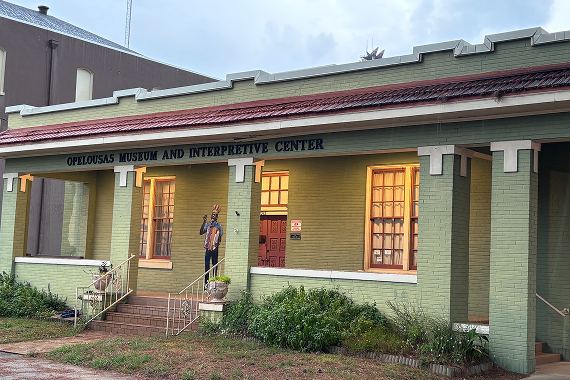
No road trip through Louisiana is complete without a visit to the Opelousas Museum and Interpretive Center. In its day, the museum served as a library, church, and funeral home before becoming the museum it is today. Inside its walls, you'll find the memories of Opelousas in its replica of an old barbershop, the Civil War Room, its Zydeco artifacts, and even its doll collection. Each exhibit speaks to a different facet of the Opelousas personality.
Every so often, you come across something in the "I was today years old when I learned" category. In other words, something you feel like you should've already known. One such bit of history is just might be that before the Civil War, St. Landry Parish was home to the second-largest population of free people of color in the entire state of Louisiana. The free people of color were families who owned land, ran businesses, and raised children in a society that enslaved others of their race.
This dichotomy gave way to a truly unique culture and people, lucidly brought to life at the Opelousas Musuem's latest exhibit. It tells the story of the area's free people of color via photographs, documents, and domestic artifacts.
Plenty of towns claim to be the birthplace of something or other. What sets Opelousas apart is that it's got proof, and that proof is in the Opelousas Museum. Since 1996, the museum has been the repository for the original Southwest Louisiana Zydeco Music Festival archives. The exhibit isn't just a tribute to Zydeco music; it's a chronicle of how it came to be.
One of the hometown heroes featured in the museum is Clifton Chenier, born in Opelousas in 1925 and known as the King of Zydeco. With his trusty accordion in hand, he took Creole culture all the way to the Grammys. At the Opelousas Museum, you'll find stories, photographs, and other curios that paint the picture of a man—and a music—that was truly one of one.
When you're in the American south, the history of the Civil War looms large. You'd be hard-pressed to find a single town in Louisiana that doesn't have some meaningful connection to the bloodiest battle in American history. But few of their stories is as odd as Opelousas'. When Union forces took control over Baton Rouge, the capital of Louisiana, the state government fled. And for a brief period of time, they settled down in Opelousas, making the town the temporary Confederate capital of Louisiana.
The Opelousas Museum has an entire room for this story, in which you'll find period weapons, currency, and artifacts, all from the months with a small agricultural town suddenly found itself thrust into the spotlight.
We so often think of history as starting with those who first wrote it down. The Opelousas Museum remedies that by dedicating a portion of its space to the Atakapa-Ishak, the Native Americans who occupied the area along the Gulf Coast in what is now Texas and Louisiana. Using authentic artifacts as the starting point, the exhibit then tracks the history from the Atakapa-Ishak to the European settlers, how agriculture evolved, and the evolution of local business to the modern day. To understand where you are and where you're going, you must always first know where you came from. Such is the mission of the Opelousas Museum.


